
When my dad asked why I stopped coming home for Christmas, I didn’t yell or start an argument. I walked him out to the garage, put my hand flat on the workbench he never once let me touch, and said, “Because I’ve spent my whole life being the kid who built the house nobody looks at.”
My dad was not at the hospital when I was born. He wasn’t even in the city. He was at a 6 a.m. hockey tryout two towns over watching my brother Wade stop pucks while my mother drove herself to the maternity ward through a snowstorm.
He got there four hours after I did. He kept the parking stub from that rink in his wallet for years, but he never kept my hospital wristband.
The Golden Child and the Garage
Wade was the golden one. Travel hockey, double-A, then AAA, the whole machine.
My dad drove him 90 minutes each way, six days a week for nine years, and said the number out loud at Thanksgiving once like a sermon: Two hundred ninety thousand miles. He flooded a backyard rink by hand every November, dragging the hose across the yard at midnight until his fingers split. That rink had a floodlight you could see from the end of the street, but my bedroom window faced the other way.
I didn’t play anything. I went into the garage.
I taught myself to clean a joint because wood was the one thing in that house that did exactly what I told it to, and because the garage was the only room nobody fought over. It’s quiet work. You disappear into it for hours and walk out with something that stays.
When I was 15, I entered the county fair with a walnut box I’d built from a maple that fell on our road. I took first place. My dad didn’t come. There was an exhibition game that weekend—not even a real one—and he left before the judging to catch the second period. I carried that box home on the bus and told my mother I bought it.
Once, through the vent in the garage ceiling, I heard him tell my uncle why he poured everything into Wade.
“A shot like that comes once,” he said. “You don’t split your chips on a maybe.”
I was the maybe.
Then Wade blew out his knee at 20 and never skated again. My dad didn’t drive anywhere for a year.
The Stolen Masterpiece
Meanwhile, I became a carpenter—a real one, the kind people wait eight months for.
When I was 22, I built my parents a dining table out of black walnut, featuring hand-cut dovetails and a single-slab top I flattened over three weekends. I hauled it home in a borrowed truck and set it in their kitchen because I wanted, just once, to give my father something only I could make.
Two years later, my aunt mentioned he’d shown it off at a cookout and told everyone he built it himself. “Always been good with my hands,” he’d said.
I didn’t correct him. We ate Christmas dinner on that table for nine years, and he said grace over it every single time.
Last spring, my dad retired from the shop he’d run for 31 years. They rented the Union Hall. Somebody made a slideshow, and I counted—because counting is a thing I do now—and out of 170 photos, three had me in them.
Then he stood up, thanked his crew, thanked my mother for her patience, and thanked Wade for keeping him young. Finally, he announced he was leaving the shop and every tool in it to Cal, the neighbor kid who’d swept his floors for two summers.
“The boy I taught everything,” he called him.
Cal can’t cut a straight miter. I’ve been a master carpenter for 11 years.
I stood at the back of the hall and clapped. My name was not said once.
Looking Underneath
Afterward, he found me by the door, loose and warm from the beer, and put his arm around my shoulder—maybe the fourth time in my adult life he’d done that.
“You’ve gotten so distant,” he said, not angry at all, but with a genuine puzzle in his voice, like I was a drawer he couldn’t work out how to open.
So that Christmas Eve, I asked him to help me lift the table to sweep under it. He took one end. I took the other. We raised it, and I told him to hold it there, tilted up on its side.
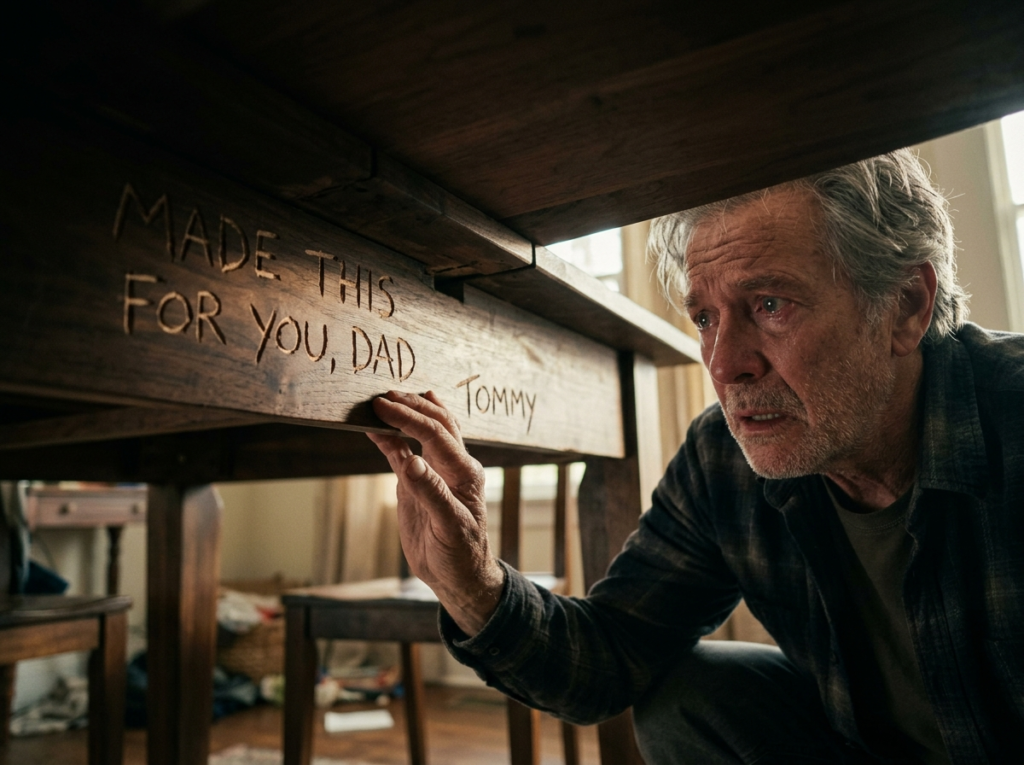
I pointed to the underside of the top—to the corner where the light never reaches—where I had carved deep into the walnut when I was 22: My name, the year, and one line: Made this for you, Dad.
He went quiet. He looked at it for a long time. Then he looked down at his own two hands, the ones he’d told everyone had built it.
I set my end back down on the floor.
“You’ve said grace over my work for nine years,” I told him. “You just never once looked underneath.”
How the Internet Reacted
When stories of parental favoritism and unappreciated sacrifices circulate online, readers analyze the emotional impact through several poignant lenses:
- The Pain of Being the “Maybe”: Commentators deeply sympathize with the emotional toll of watching a parent pour all their resources and validation into one sibling while ignoring the other.
- The Power of Silent Resentment: Readers note how keeping quiet about achievements to avoid conflict eventually culminates in a powerful, undeniable truth bomb.
- Validation in Craftsmanship: Online communities praise the son’s incredible dedication to his trade, proving his worth through master-level carpentry despite his father’s blindness.
What Would You Have Done?
When a parent takes credit for your life’s work while ignoring your existence, how would you handle the confrontation? Would you have revealed the hidden inscription like he did, or walked away for good?
Share your thoughts and perspectives in the comments section below!