
Growing up, privacy wasn’t just discouraged in my household; it was treated as a psychological disease.
My father believed that families who slept separately grew apart and became selfish monsters incapable of real love. To prevent this, he demanded that all four of us children sleep in his and our mother’s king-sized bed every single night until we got married.
He eliminated every single door in the house except the front door. There were no doors on our bedrooms, no doors on the hallways, and no doors on the bathrooms. We had to use the toilet out in the open where everyone could see, and shower with a “buddy” to maintain what he called absolute family closeness.
At night, our sleeping arrangements were regulated with terrifying precision. My father would arrange us in specific positions—the youngest closest to my mother, and the older children on the outer edges. He would measure the gaps between our bodies with a ruler to ensure we were as close as physically possible.
He monitored our breathing patterns while we slept and would wake us up if we rolled too far away from the family cluster.
The House Without Doors
By the time I turned thirteen, I realized that other families did not live like this. When I finally worked up the courage to ask for my own bed, my father looked at me with genuine horror.
He sat us all down and laid out his core theory: “Every night apart weakens the family unit, and children who sleep alone learn to love themselves more than their blood.”
He even showed us bizarre, cherry-picked articles about serial killers who had their own bedrooms as children, claiming it was undeniable proof that physical separation created psychopaths.
From that day on, the rules became even stricter. Because I had dared to ask for privacy, he decreed that I needed to be in physical contact with at least two family members throughout the entire night to ensure I didn’t turn into a monster.
Living like that meant constant, grinding exhaustion. We could never have friends over, we could never have sleepovers, and we constantly had to lie about why our house had no doors and why we always looked like we hadn’t slept in years.
Dating was strictly forbidden. My father insisted that spending time close to anyone outside the family would “contaminate our bond.”
Breaking Away for College
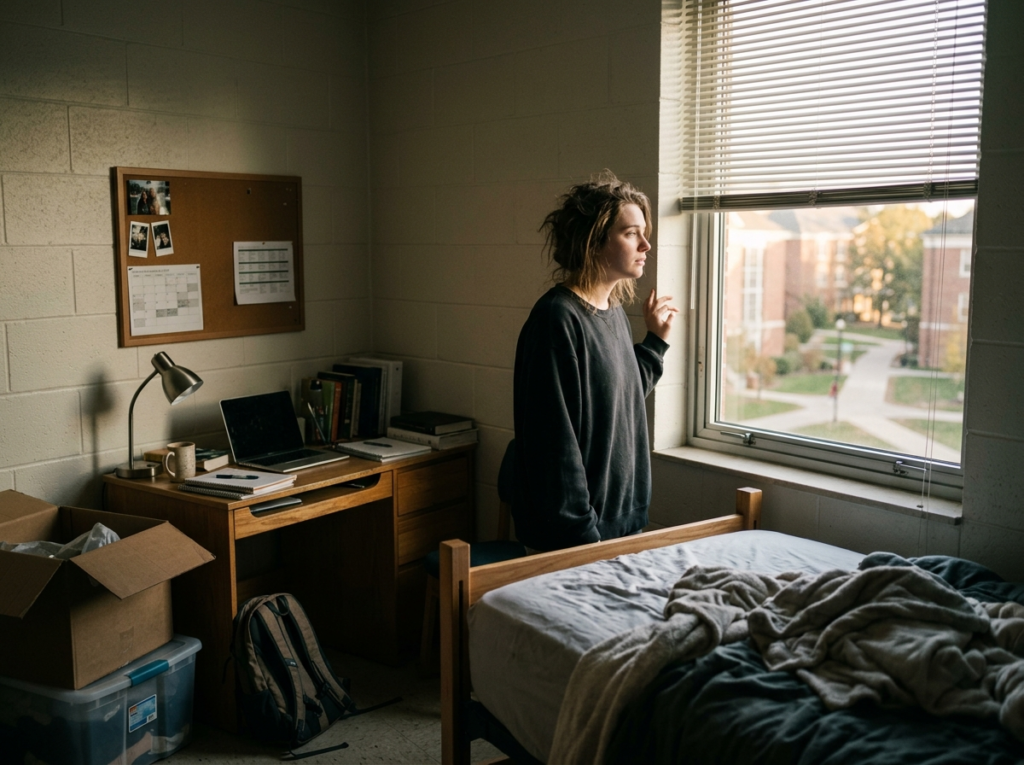
When I received my acceptance letter to a university five hours away, I thought I had finally found my ticket to freedom. I secretly saved every dollar I earned from high school tutoring jobs and paid for a single dorm room deposit behind my parents’ backs.
When I announced I would be living on campus, my father snapped. He grabbed my wrist with a bruising grip.
“You’d rather sleep surrounded by strangers than the people who created you?” he hissed.
I yanked my arm away, looking him dead in the eye, and told him the truth: normal families do not share beds with adult children, and what he was doing was deeply sick.
My mother immediately began wailing, accusing me of tearing our family apart. But I refused to back down. I packed what little I could carry into duffel bags and left for campus weeks early, spending the first two weeks sleeping in my car in the student parking lot until the dormitories officially opened.
The College Stalking Incident
I thought escaping the house was the hard part, but I was wrong.
On move-in day, my family arrived in a cargo van, parked directly outside my residence hall, and demanded that I let all of them into my tiny single dorm room so we could “fulfill our nightly sleep obligation.”
When campus security told them non-students couldn’t enter the building, my parents played the victim to perfection. They told the guards they were homeless and needed to stay close to their daughter for safety. They quickly gained the sympathy of passing students while setting up camp right outside my door.
For days, they slept in a literal human pile on the floor of the hallway, blocking foot traffic and hissing at anyone who walked past that I was a cruel, ungrateful child.
My father slipped frantic handwritten notes under my dorm door every few hours, complete with mathematical diagrams showing how he could fit all six of us onto my standard twin mattress and calculating the exact number of “bonding hours” I had stolen from the family.
The Arrest and the Discovery
The climax came on the eighth day. As I stepped out of my dorm to head to class, my father lunged forward and tried to physically drag me toward the stairwell and into their van.
He screamed at the top of his lungs about the twenty thousand hours of family bonding I had stolen from them, right in front of thirty witnesses.
Campus police arrived within minutes and slapped handcuffs on him for assault.
When officers searched the cargo van for identification and belongings, they made a horrifying discovery. They found dozens of thick, meticulously maintained ledgers dating back fifteen years.
Inside were detailed daily logs of every child’s sleeping positions, exact body temperature readings, and proximity measurements taken every single night.
The responding officers were visibly shaken. My younger siblings were immediately removed from my parents’ custody by child protective services, while I was finally granted emergency restraining orders.
The nightmare was over, but the recovery was just beginning.
How the Internet Reacted
When extreme stories of parental control and family enmeshment are shared online, readers analyze the psychological and legal aspects through several lenses:
- Severe Enmeshment: Mental health professionals and online commentators point out that forced physical proximity is a textbook example of psychological control disguised as “love.”
- Systemic Intervention: Readers express immense relief that campus police and child protective services intervened quickly once documentary evidence of the abuse was uncovered.
- The Courage to Leave: Online communities praise the narrator’s incredible resourcefulness in saving money and escaping a deeply dangerous environment.