
Being with someone who is a “good drunk” is a special kind of psychological trap.
My fiancé, 27-year-old Mark, is the kindest man most people will ever meet. He has never raised his voice at me, not even once. He rubs my tired feet after I get home from a brutal 10-hour shift at the bakery, and he leaves sweet little handwritten notes tucked inside my lunch bag.
Everyone who knows him thinks he hung the moon—especially his mother, who calls me her “angel” and is paying for our entire upcoming wedding.
But there is another side to Mark that the rest of the world never sees. Four nights a week, he drinks until he cannot stand up.
The House of Chaos
When we first started dating, I only ever saw him nurse a couple of beers on a Friday night. Once we moved in together, the reality surfaced. Now, he starts drinking the moment he walks through the front door and doesn’t stop until every bottle is empty.
He isn’t mean when he’s intoxicated. That is what makes it so impossibly hard to walk away. He gets overly affectionate, tells me I’m pretty, and tries to dance with me in the kitchen.
Then the dangerous chaos begins.
- The Stoves: He tries to cook elaborate meals at midnight and completely forgets the burner is on. Twice, I have woken up to thick, choking smoke billowing from a pan left unattended on the stove.
- The Security Hazards: He frequently leaves our front door wide open to the street, stumbles through spilled bacon grease, or—most bizarrely—hides frozen pizzas in my sock drawer.
- The Routine: The next morning, he cheerfully brings me coffee, apologizes with a sheepish smile, and heads off to his day job. He has never missed a single day of work, and none of his coworkers have a clue.
I used to stay home trying to manage the household, scrubbing the kitchen floors just to watch him wreck them all over again. Desperate for an escape, I got a job at a local bakery. I wake up at 4:00 AM every single morning, work on my feet for ten hours, and come home to yesterday’s mess.
Sleeping as a Night Nurse
The messy kitchen and the smoked-up apartments are not even the worst parts. The terrifying part is his breathing.
When he passes out from drinking, his breathing simply stops. The first time it happened, I woke up in a panic, screaming and shaking his violently until he finally gasped and rolled over.
In the morning, he laughed it off. “I must have dreamed it,” he said.
He hadn’t dreamed it. It happens almost every single time he drinks.
My sleep schedule has devolved into a cycle of sheer terror: I lie awake in the dark, counting silently in my head—one, two, three… If I reach ten and he hasn’t inhaled, I have to smack his back hard until he gasps for air. Then I lie back down and wait for the next episode.
+-----------------------------------------------------------------------+
|                    THE NIGHTLY SLEEP CYCLE PROTOCOL                   |
|                                                                       |
|  • Step 1 ──> Wait for Mark to pass out into deep alcoholic sleep     |
|  • Step 2 ──> Keep hand on his chest; mentally count: 1, 2, 3...       |
|  • Step 3 ──> If count reaches 10+, forcefully smack his back         |
|  • Step 4 ──> Repeat cycle all night until morning alarm              |
+-----------------------------------------------------------------------+
I sleep with my hand permanently resting on his chest now. It’s an involuntary reflex.
Once, I foolishly tried drinking along with him, hoping it would dull my anxiety. I woke up at 3:00 AM to find his lips turning a frightening shade of gray. Because I was buzzed too, nobody had been keeping count. I haven’t touched a drop of alcohol since that night.
When I beg him to see a doctor, he insists he sleeps fine. Of course he does—he’s the one sleeping. I am the one acting as his night nurse.
The Mother-In-Law’s Blind Spot
Mark’s mother, Linda, thinks he is faultless. She has loved me like a daughter since day one.
When we first moved in together, she drove over, carried his heavy boxes up the stairs herself, kissed my cheek, and whispered, “He’s all yours now.”
She has thrown herself into planning our wedding. She picked the reception hall, bought my dream dress, and even begged us to move the date closer.
“Why wait?” she told me once with a heavy sigh. “I’ve begged him to quit drinking for years. He always promises he will change.”
Six months ago, I reached my breaking point. I packed a suitcase, zipped it shut, and set it right by the front door.
When Mark saw it, he collapsed onto the floor in tears. He dragged every remaining bottle from the cabinets and poured them down the kitchen sink. He stayed completely sober for one month.
That month was the happiest of my life. We took evening walks, he fixed our broken back fence, and I finally slept eight uninterrupted hours a night. I forgot what mental exhaustion felt like.
Then, while looking for the dog’s leash in the master closet, I found a half-empty bottle hidden inside one of his work boots.
I didn’t scream. I just placed it back where I found it. By that weekend, he wasn’t even bothering to hide the bottles anymore.
Counting to Fourteen
Last night was the worst episode yet.
Around 10:00 PM, I found him passed out cold on the bathroom tile floor. It took me twenty agonizing minutes of dragging and pulling just to get his dead weight onto the bed.
Soon after, his breathing stopped.
I started counting. I hit ten, smacked his back, and he gasped.
An hour later, it happened again.
On the third episode, my internal count stretched to fourteen. Fourteen seconds. I had never made it past twelve before. My heart stopped. My hand was hovering over my phone, my thumb trembling over the 9-1-1 keypad, waiting to call for an ambulance, when he finally sucked in a massive, ragged breath of air.
I didn’t sleep for the rest of the night. I sat bolt upright on the edge of the mattress, staring at his chest rising and falling until my morning alarm blared at 4:00 AM.
I called in sick to the bakery for the first time in years. Mark woke up at 7:00, kissed my forehead tenderly, and walked out the door to work, completely unaware of how close he had come to not waking up.
The Chilling Confession
Later that morning, Linda stopped by our house unannounced to drop off the finalized wedding guest list.
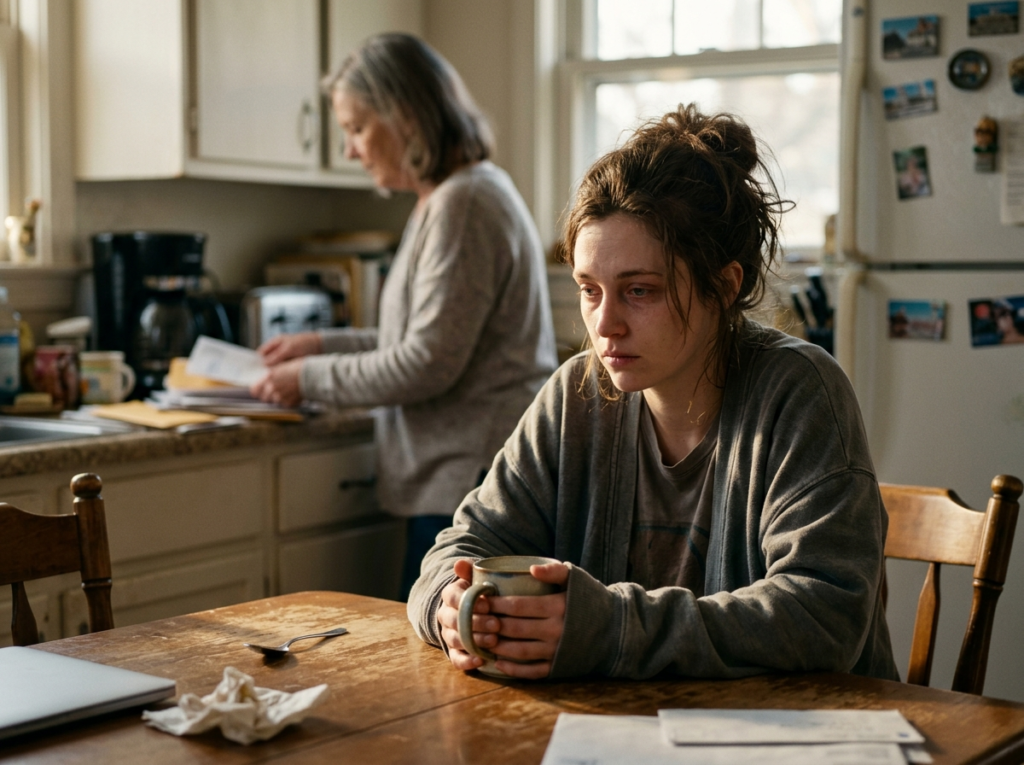
I was still sitting at the kitchen table wearing yesterday’s wrinkled clothes, my eyes bloodshot from exhaustion. She took one look at my face and immediately dropped her keys. “What’s wrong? Are you sick?”
The dam broke.
Pouring out my soul through heavy sobs, I told her everything. I told her about the smoking stoves, the open doors, the bottles hidden in work boots, and the night terrors.
I told her about the sleep apnea, and how last night I had counted to fourteen seconds before he drew breath.
I looked her in the eyes and whispered that I couldn’t marry her son. My voice shook violently the entire time.
I braced myself for her reaction. I assumed she would cry, get defensive, call me dramatic, or accuse me of exaggerating.
Instead, Linda didn’t flinch. She didn’t drop a single tear or express a shred of shock.
She simply walked forward, set the guest list neatly down on the kitchen counter, and smoothed the paper flat with her palm.
Then she looked up at me, patted my trembling hand with cold familiarity, and said:
“Don’t smack his back, honey. Just roll him onto his left side. It works faster.”
I froze, staring at her in stunned silence.
She offered a sad, weary smile, patting my hand again. “I counted for six years, honey. Then he met you… and I finally got to sleep.”
How the Internet Reacted
When stories of hidden addiction and generational enabling are shared online, readers analyze the psychological dynamics through several critical perspectives:
- The Burden of Caregiving: Commentators point out how easy it is for an enabling partner to slip into the role of a nurse or caretaker, sacrificing their own health and sleep to keep an addict alive.
- The Reality of Generational Enabling: Readers express deep horror at the mother-in-law’s chilling confession, realizing that she knowingly passed her exhausting, dangerous burden onto a younger woman.
- The Final Wake-Up Call: Online communities strongly urge individuals in similar situations to walk away immediately before a tragic accident or medical emergency occurs.
What Would You Have Done?
Discovering that your partner’s severe addiction is an inherited cycle you were unknowingly brought in to manage changes everything. Would you have handed back the wedding ring immediately after hearing his mother’s confession?
Share your thoughts and perspectives in the comments section below!